


Design Thesis
- Aleksandra Szwedo
- Apr 29, 2019
- 2 min read
In the era of regeneration schemes entire areas often become gentrified and the modernist heritage of council housing falls victim to new, high-end private developments. Displaced communities of residents from demolished estates are scattered around and outside of the city forced to reestablish their new homes and social support structure.
A growing ambition of mine was to work on and propose a project that would critically address the issue of displacement and tabula rasa stemming from private-led regeneration schemes. As a result, my thesis explores the idea of retrofit offering a retrofit scheme with the purpose to return the value to the chosen modernist estate and by extension any devalued housing estate standing at risk of potential demolition.

The northern part of Southwark Borough in London became the general area for primary research. In the search for sites accommodating existing structures appropriate for a retrofit scheme, Elephant and Castle area came to the forefront. Its diverse character rich with mixed communities together with a prime location have led to the area becoming of interest for a regeneration scheme. This has resulted in one of the existing housing estates, Heygate, being demolished between 2011 and 2014.
Just across the street from Heygate there is Draper Estate once housing the tallest high rise in England and today being far away from its former glory. Standing at risk of facing a similar fate to the sold, demolished and currently redeveloped Heygate Estate, Draper Estate has been chosen as the site and the basis for the retrofit scheme. The map below represents council estates present within the research area juxtaposing the demolished sites with the regeneration areas.

The design thesis pursues two main themes; the in-adaptability of current housing models resulting in the need to move several times over the course of one’s life , as well as the presence of nature in cities which is often reduced to a highly manicured decorative aspect serving no wider purpose.
Designed as a kit of parts the scheme strives to be adaptable to a variety of existing building forms. Furthermore, the proposal offers an opportunity to manipulate one’s home footprint by allowing the residents to extend or decrease their home area within the structural frame.

Retrofit by nature bases on the biophilia theory popularised by Edward O. Wilson arguing that human innate tendency is to seek connections with nature. Combined with the issues of sustainability within cities the project proposes an urban farm at London’s heart. Serving as an alternative for traditional farming that large cities depend on, the Draper Farm combines both soil and soilless techniques of growing food that celebrate the functional rather than purely aesthetic aspect of nature as well as bring together the residents of the estate and the surrounding area. Apart from the architectural adaptability, the project proposes a cyclical system to be established on the estate creating its own economy that would be beneficial both within and beyond site’s boundaries. The diagram below shows the relationships between all design components.
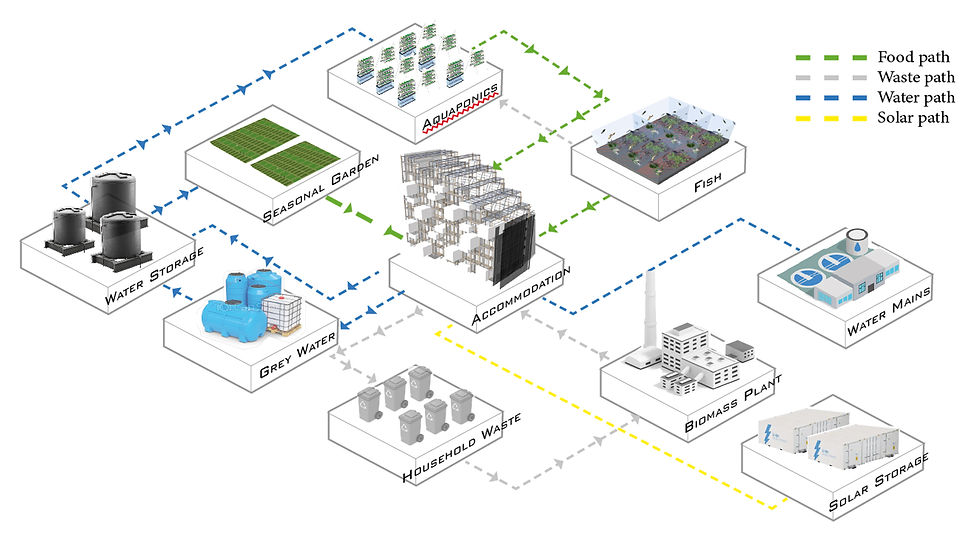
The project celebrates the modernist council housing heritage by retrofitting existing architecture, providing affordable housing with new public spaces and challenging the urban definition of nature by allocating it a functional character of food cultivation.


Comments